IO-AI Tech Launches EmbodiFlow 2.0: Unified Multi-Source Data Processing with Customizable Algorithms & Workflows
From raw recordings to training-ready datasets, making embodied AI data processing more flexible and efficient.
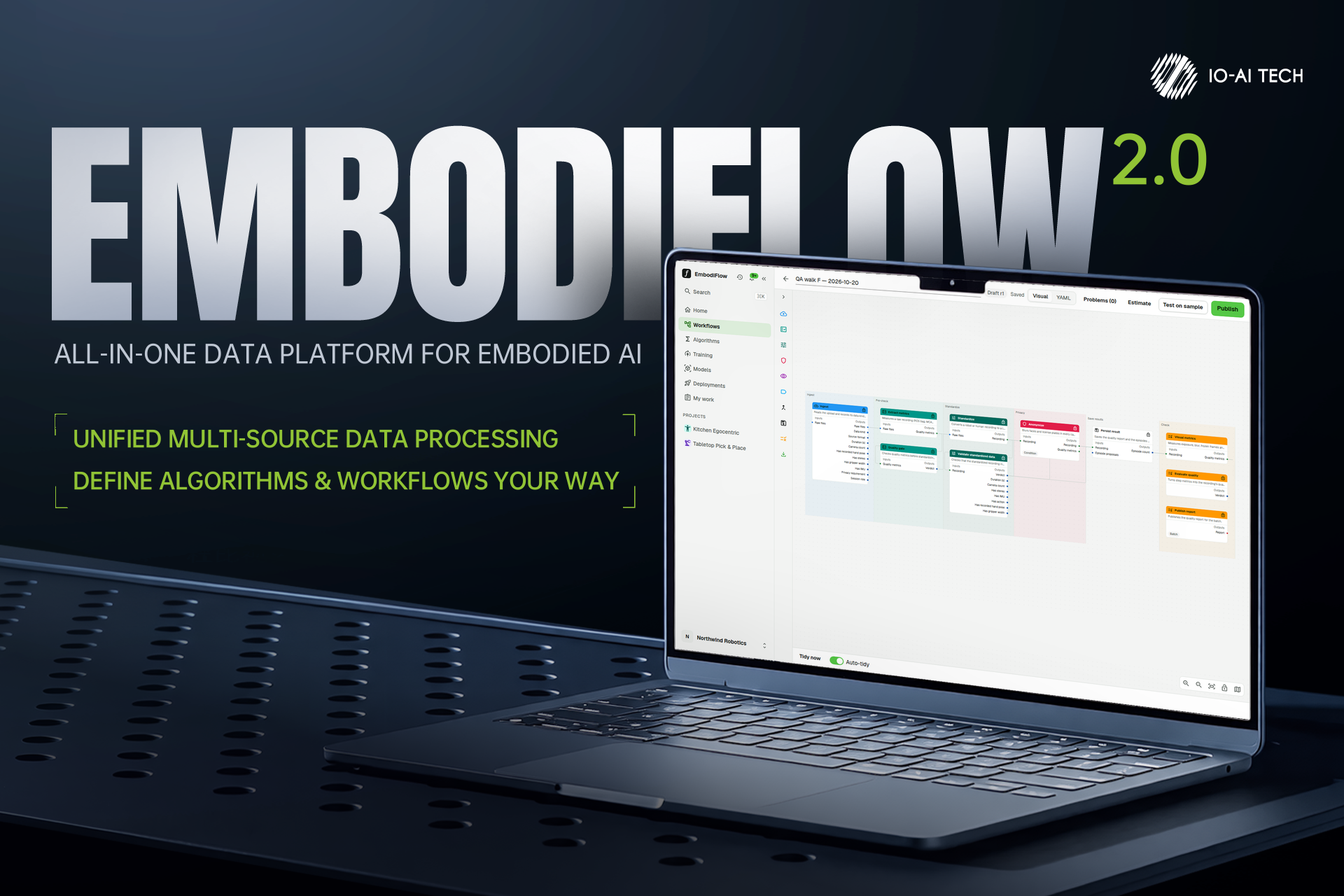
IO-AI Tech today announced the launch of EmbodiFlow 2.0, its all-in-one data platform for embodied AI.
Product Introduction: https://www.embodiflow.io
User Documentation: https://docs.embodiflow.io
As embodied AI advances, the sources of real-world training data are becoming increasingly diverse. Beyond robot teleoperation, more teams are collecting first-person human data using wearable cameras and manipulation data through UMI grippers.
Yet, as data collection scales, processing that data into training-ready datasets remains a major challenge.
Through our work with robotics research and development teams, we have identified several recurring pain points:
-
Fragmented data formats: Different devices produce different data formats, sensor modalities, and timestamps. Integrating a new device often means writing another set of conversion scripts.
-
Complex human data processing: Raw first-person recordings typically contain videos and sensor readings, but hand poses, camera poses, and depth information still need to be estimated. Anonymization and episode segmentation add further processing steps.
-
Hard-to-reuse workflows: Quality checks, annotation, and data conversion often depend on individual scripts. Proven methods are difficult to share across teams, while new processing requirements may depend on platform-specific customization.
-
Limited data quality visibility and traceability: Data issues may only surface during model training, making it difficult to identify problematic recordings or trace a trained model back to its source data.
EmbodiFlow 2.0 is designed to address these challenges.
This release focuses on two major improvements: a significantly enhanced processing pipeline for human data, and the flexibility to build data workflows using both built-in and custom algorithms.
What's New in EmbodiFlow 2.0?
- Unified Processing of Multi-Source Data
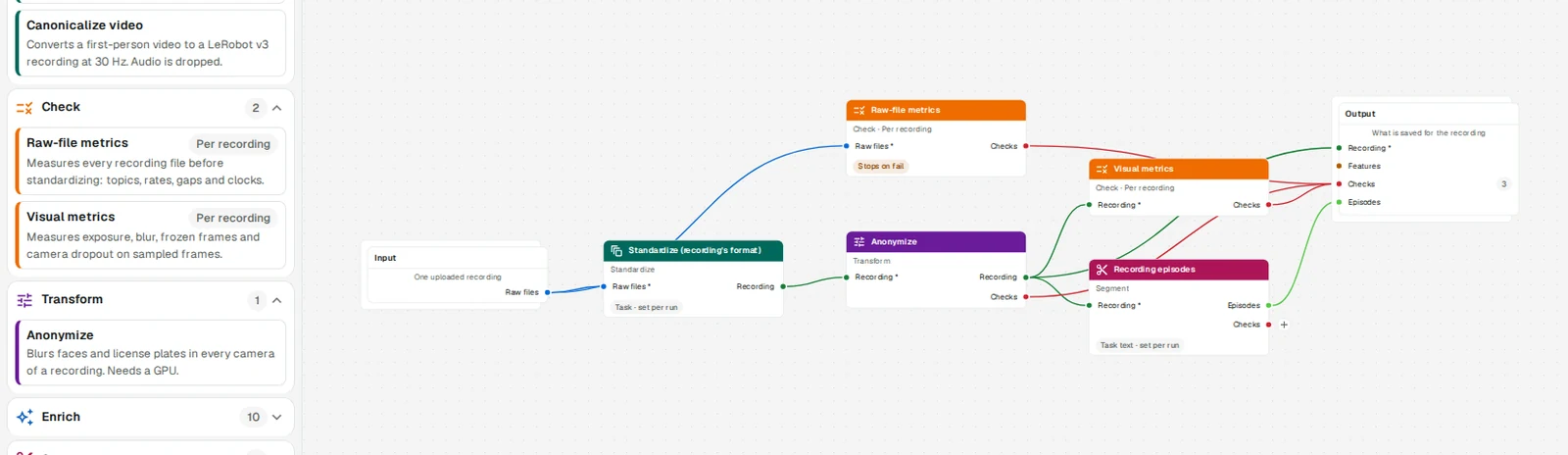
Previously focused primarily on robot teleoperation data, EmbodiFlow now supports dedicated processing workflows for robot teleoperation, first-person human data, and UMI data, with standardized output in LeRobot v3.
- Customizable Algorithms & Workflows
Instead of relying on fixed processing pipelines, teams can now combine built-in algorithms and workflow templates with their own algorithms, replacing or adding processing steps as needed.
- A Trusted, Traceable Data Pipeline
From quality inspection and synchronized playback to dataset versioning, model training, and deployment, EmbodiFlow brings the data lifecycle into one platform, enabling traceability from trained models back to original recordings.
With EmbodiFlow 2.0, teams can spend less time rebuilding processing scripts and more time developing the data pipelines that fit their specific research and deployment needs.
01 | Unified Multi-Source Data Processing, with Enhanced Support for Human Data
Different data collection methods produce fundamentally different types of recordings.
Robot teleoperation data typically includes multiple camera streams, joint states, and action sequences. First-person human data often requires additional reconstruction and estimation. UMI data involves its own calibration, mapping, and localization processes.
EmbodiFlow 2.0 provides dedicated workflows for three major data sources:
-
Robot Teleoperation Data: Automatically organizes uploaded recordings, including multiple camera streams, joint states, and actions, with quality checks and synchronized playback.
-
First-Person Human Data: Supports face anonymization, hand pose estimation, camera pose estimation, and depth estimation through an integrated processing pipeline.
-
UMI Data: Provides ready-to-use workflows for calibration, mapping and localization, and gripper open/close detection.
Once recordings are uploaded, the corresponding workflows can automatically process the data without requiring teams to manually execute separate scripts for each source.
A Major Upgrade to Human Data Processing
Processing first-person human recordings has traditionally required combining multiple open-source models and writing substantial integration code. Switching to a different wearable camera or recording setup could mean rebuilding parts of the pipeline.
EmbodiFlow 2.0 brings these steps together.
After uploading a recording, the human data workflow can automatically perform face anonymization, hand pose estimation, quality checks, and task episode segmentation.
In one of our demonstrations, a 22-minute towel-folding recording was automatically segmented into 63 task episodes, each accompanied by a generated task description.
After human review and confirmation, these episodes can be incorporated into training datasets.
One Standardized Format: LeRobot v3
EmbodiFlow standardizes data from different recording devices by aligning their timelines and converting them into LeRobot v3.
This unified format simplifies downstream quality inspection, filtering, and data augmentation, while allowing exported datasets to be read directly by LeRobot and Hugging Face tools.
Standardization does not mean losing the distinctions between different data sources. The platform preserves the meaning and attributes of actions across recording types while providing a consistent structure for data management and training.
02 | Built-In Workflows, with the Freedom to Bring Your Own Algorithms
No two robotics teams use exactly the same hardware, data processing methods, or model architectures.
A single fixed pipeline cannot accommodate every requirement.
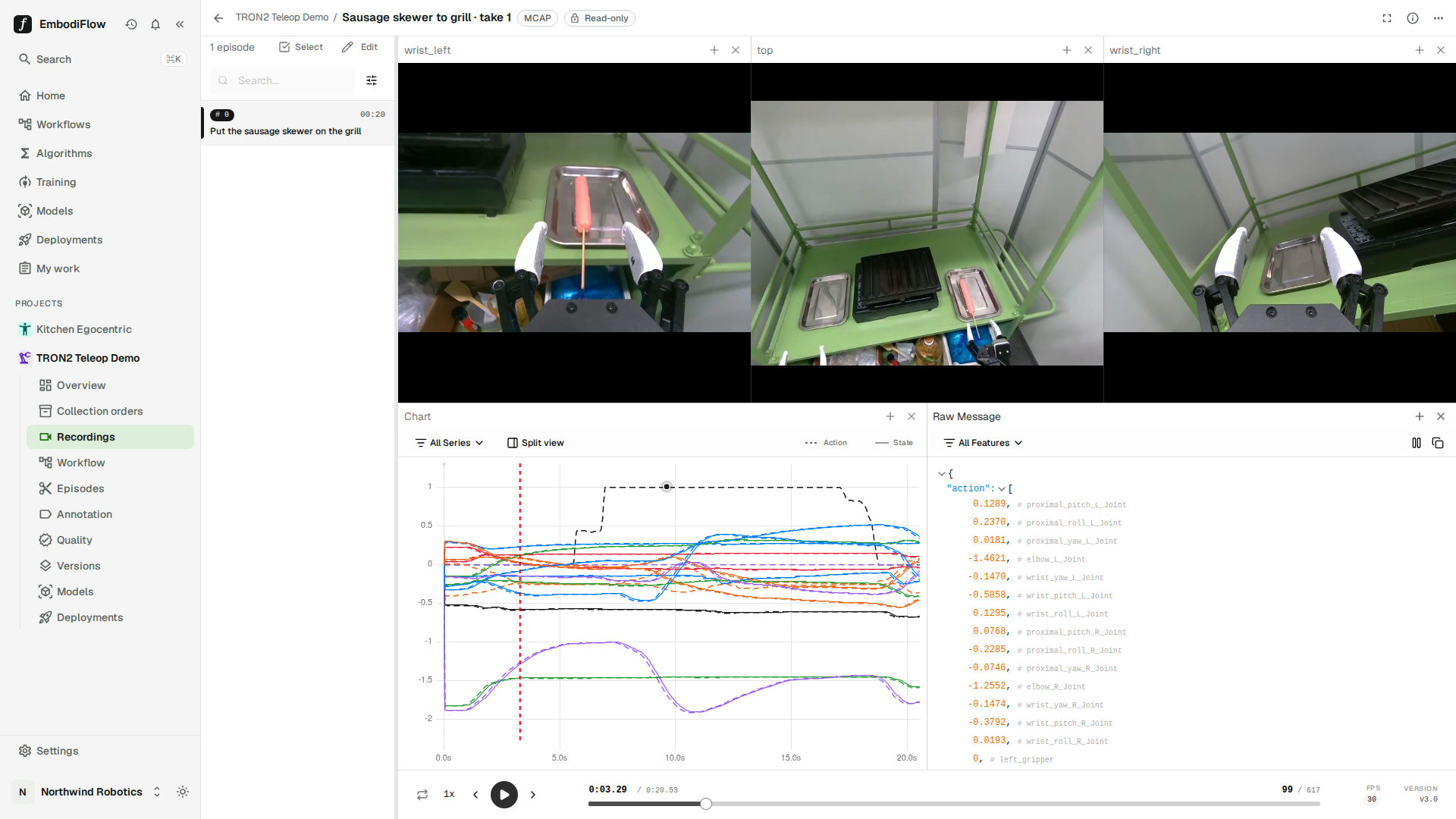
EmbodiFlow 2.0 addresses this by breaking data processing into modular algorithms. Each step in a workflow can be replaced, customized, or extended.
Start with Ready-to-Use Algorithms and Templates
EmbodiFlow includes built-in algorithms for common processing operations, including:
-
Data standardization and format conversion
-
Data quality inspection
-
Task episode segmentation
-
Dataset export
-
Hand pose and camera motion estimation
-
Depth estimation
Official workflow templates are also available for robot teleoperation and first-person human data.
Teams can start with an existing template, modify individual steps, and quickly build a workflow that fits their project requirements.
Integrate Your Own Algorithms
Many robotics teams have developed specialized algorithms for their own applications.
For example, a team may have a proprietary hand pose estimation model or a quality inspection rule that requires a robot gripper to remain visible throughout a recording.
With EmbodiFlow 2.0, teams can write algorithms directly in the browser or integrate existing algorithm implementations.
An algorithm can be tested against a real recording, with results visualized for inspection. Once validated, it can be saved as a version and added to a workflow.
Teams can then drag the custom algorithm into the visual workflow editor, replace an existing processing step, and publish the updated workflow to a project.
Every new recording uploaded to that project can then be processed automatically using the customized workflow.
Turn Individual Solutions into Reusable Team Workflows
EmbodiFlow's visual workflow editor allows users to build pipelines through drag-and-drop operations, test them on selected recordings, and publish them for regular use.
Once published, execution is handled by the platform. Algorithm versions, processing parameters, and workflow changes are recorded for traceability.
Built-in and custom algorithms can also run together within the same workflow.
This allows teams to turn successful processing methods into reusable workflows rather than leaving them scattered across individual computers.
When new devices or processing requirements arise, teams can extend their workflows independently, reducing their reliance on platform-specific custom development.
03 | A Trusted Data Pipeline, from Quality Control to Model Training
Processing data is only part of the challenge.
Robotics teams also need to answer two important questions:
Can we trust the quality of this dataset? And can we trace a trained model back to the exact data used to build it?
EmbodiFlow 2.0 connects quality inspection, synchronized playback, AI-assisted annotation, dataset versioning, and model training within a traceable data pipeline.
Synchronized Playback Across Multiple Data Streams
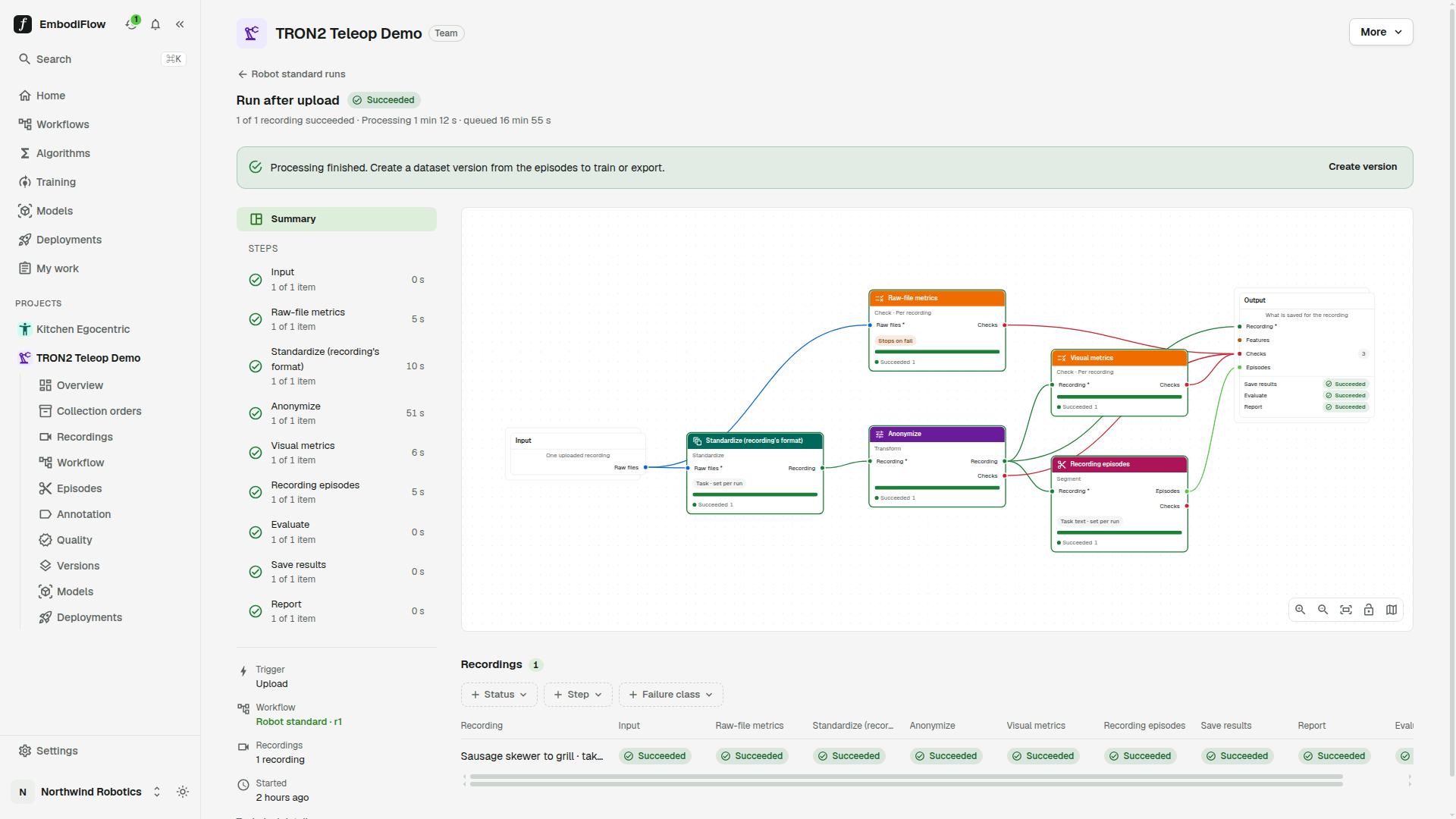
EmbodiFlow supports synchronized playback of multiple camera streams, joint trajectories, and raw sensor messages along a shared timeline.
This makes it easier to inspect recorded demonstrations and locate potential problems during data collection.
The playback capabilities are built on ROSView and LeRobot Studio, visualization tools developed and open-sourced by IO-AI Tech.
Identify Data Quality Issues Before Training
Dropped frames, incorrect timestamps, and blurry images can significantly affect training data quality.
In many workflows, such problems are discovered only after model performance falls short of expectations.
EmbodiFlow introduces quality checks early in the processing pipeline, allowing problematic data to be identified before it reaches downstream processing and training.
Data can also be excluded at the individual task episode level, rather than discarding an entire recording.
This means valid episodes can still be retained and used, even when other portions of the same recording fail quality inspection.
AI-Assisted Annotation, with Human Review
Long, continuous recordings often require extensive manual segmentation and annotation.
EmbodiFlow uses AI to propose task episode boundaries, generate task descriptions, and suggest skill labels based on recording content.
Human annotators can then review, adjust, and confirm these suggestions before the annotations are finalized.
This human-in-the-loop approach reduces repetitive manual segmentation and labeling while keeping people responsible for reviewing the results.
Immutable Dataset Versions for Reproducibility
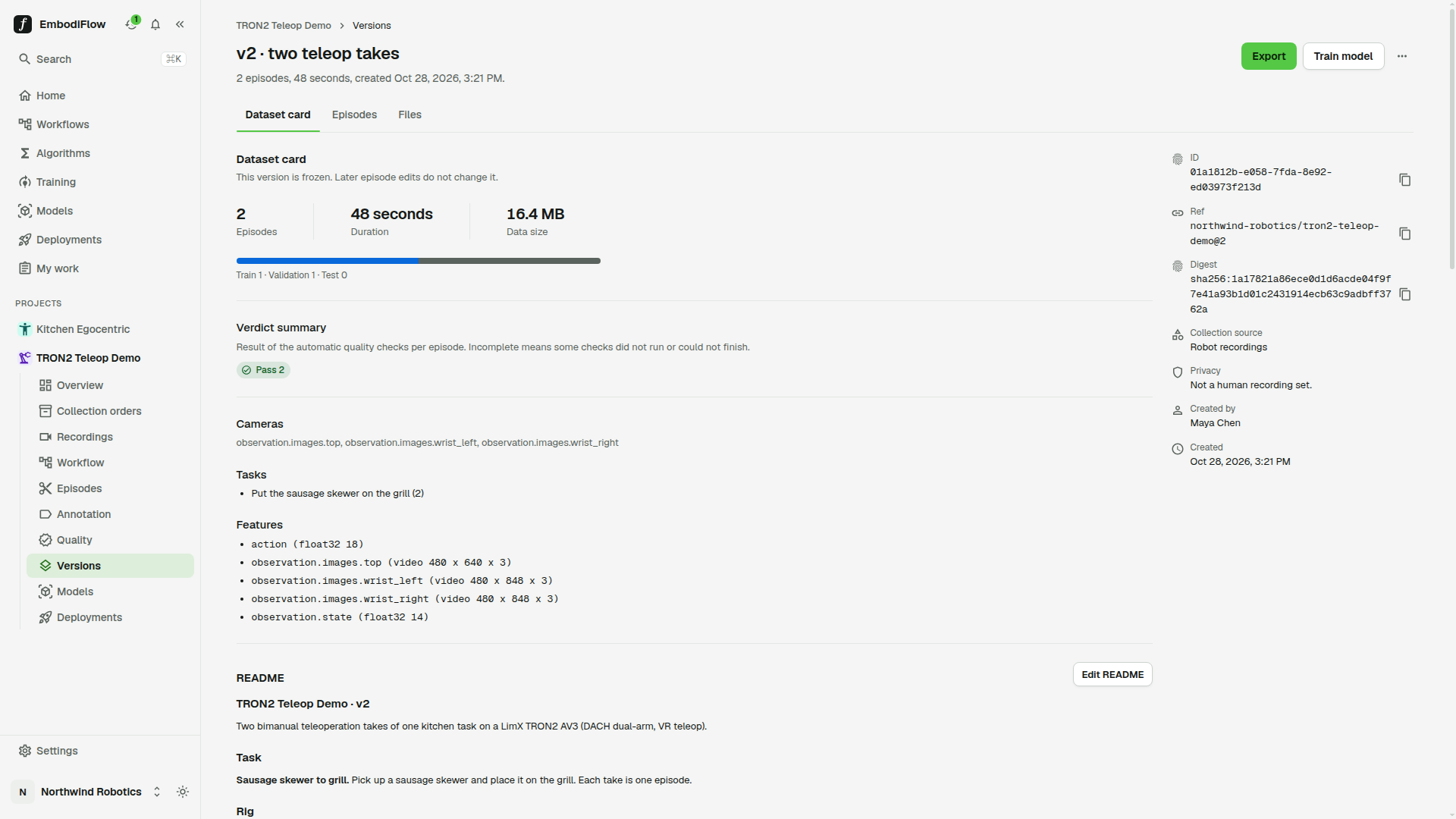
Once data has been processed and reviewed, it can be saved as a fixed dataset version.
Each dataset version is frozen when created, so newly added data does not change existing versions.
The platform records the source recordings, algorithm versions, and processing parameters used to generate each dataset.
This provides a reproducible foundation for model training, evaluation, and subsequent iterations.
From Dataset Versions to Training and Deployment
Teams can select a dataset version and initiate model training directly through EmbodiFlow.
The platform supports widely used robot learning policies and Vision-Language-Action (VLA) models, including ACT and π0.
After training, models can undergo offline evaluation before being prepared for deployment.
EmbodiFlow can then generate deployment packages to support validation on physical robots.
Throughout this process, model results remain connected to their dataset versions and original recordings.
From raw recordings to trained models, the full data lineage remains traceable.
04 | Open Integration and Flexible Deployment
Many robotics teams already have established data collection devices, processing algorithms, and training environments.
Adopting EmbodiFlow does not require replacing these existing systems.
Integrate with Existing Tools and AI Assistants
EmbodiFlow provides open interfaces that allow teams to connect the platform with their existing scripts and development toolchains.
It also supports integration with the LeRobot and Hugging Face ecosystems.
Through interfaces such as MCP, CLI, and SDK, AI coding assistants including Claude and Cursor can interact with the platform to perform supported operations.
For example, a developer could ask an AI assistant to:
"Write a quality-check algorithm that verifies whether the gripper remains visible throughout a recording, add it to the teleoperation workflow, test it on three recordings, and publish the updated workflow."
AI assistants operate under the user's access permissions, with actions recorded for auditing.
This opens up more flexible ways to build, test, and manage data processing workflows.
Cloud or On-Premises Deployment
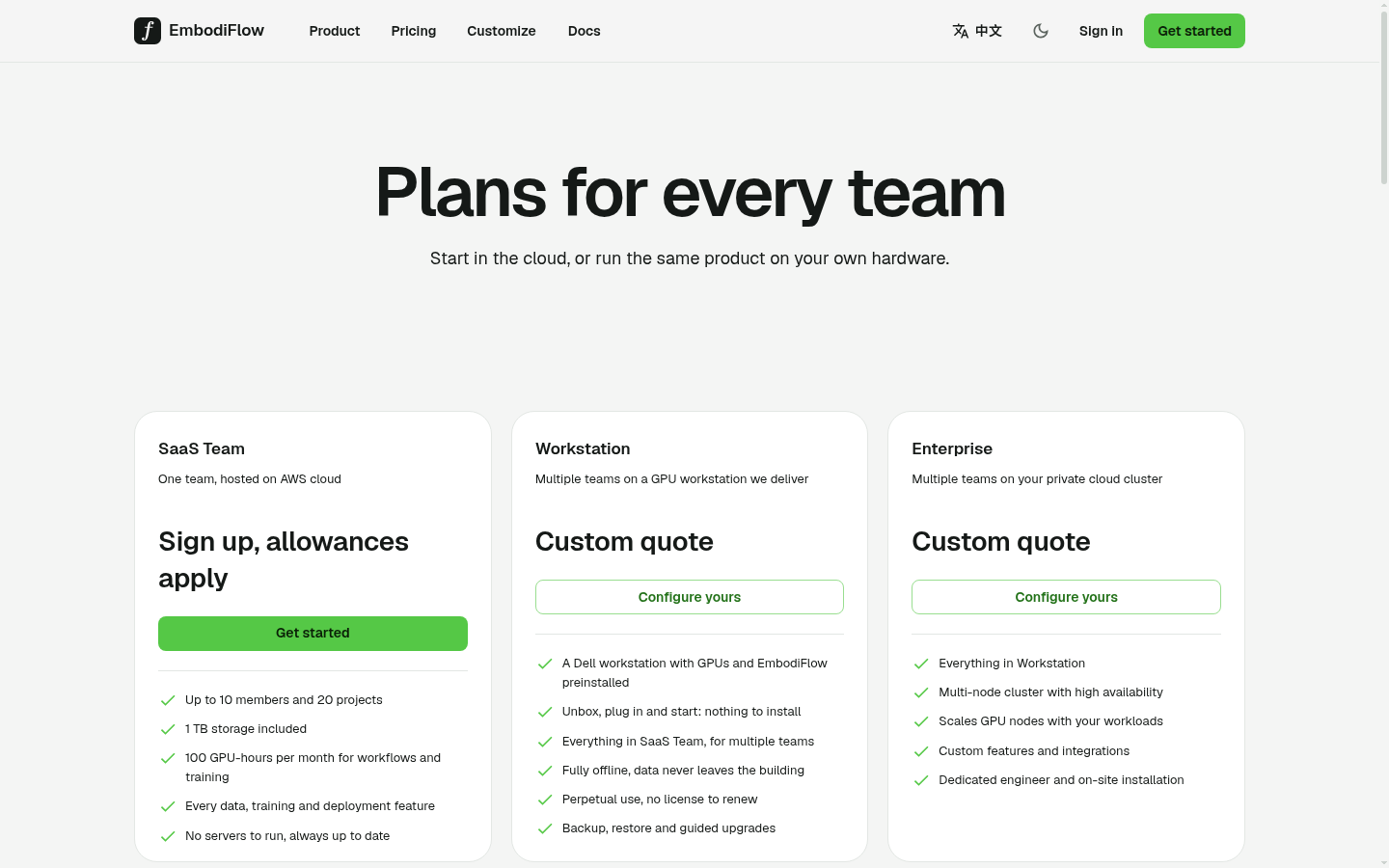
EmbodiFlow 2.0 offers three deployment options to meet different infrastructure and data management requirements.
SaaS Team — Get Started Quickly
A cloud-hosted service for teams that want to start using the platform without managing their own infrastructure.
Workstation — Keep Data On-Site
A local GPU workstation with EmbodiFlow preinstalled, supporting fully offline operation.
Designed for university laboratories, research groups, and teams that need to process and manage data within their own environments.
Enterprise — Built for Multi-Team Collaboration
Deployment within an organization's private cloud, supporting multi-node collaboration and integration with existing enterprise systems.
All three deployment options provide the same core platform functionality.
Your data and algorithms remain yours, with support for open data formats and integration with existing tools.
From Real-World Data to Continuous Robot Learning
Real-world data is fundamental to robot learning.
However, turning raw recordings into reliable, training-ready datasets remains one of the most labor-intensive parts of the development process.
At IO-AI Tech, we are building an integrated product ecosystem to make that process easier:
-
TeleXperience: A general-purpose robot teleoperation and data collection system for collecting real-world robot interaction data.
-
SenseXperience: A real-world human data collection system designed to capture multimodal human demonstrations.
-
EmbodiFlow: An all-in-one embodied AI data platform connecting data processing and management with model training and deployment.
Together, these products connect data collection, processing, and model development, helping robotics teams build more efficient workflows around real-world tasks.
EmbodiFlow 2.0 marks another step toward that goal: making it easier to turn every real-world recording into usable data for robot learning.
Learn More About EmbodiFlow 2.0
Interested in exploring how EmbodiFlow can support your robotics data workflows?
Contact IO-AI Tech to learn more about the platform and available deployment options.
Website: https://io-ai.tech/
Email: io@io-ai.tech